
Today marks a defining moment for India's space industry — and for everyone at Zetatek Technologies. On 18 July 2026, Skyroot Aerospace successfully launched Vikram-1, India's first privately developed orbital-class rocket, under Mission Aagaman, lifting off from the Satish Dhawan Space Centre in Sriharikota. With this flight, India became only the third nation in the world — after the United States and China — to have a private company demonstrate orbital launch capability. It is a moment of immense pride for our entire team, because tucked deep inside Vikram-1's guidance, navigation, and control system is a piece of Zetatek engineering.
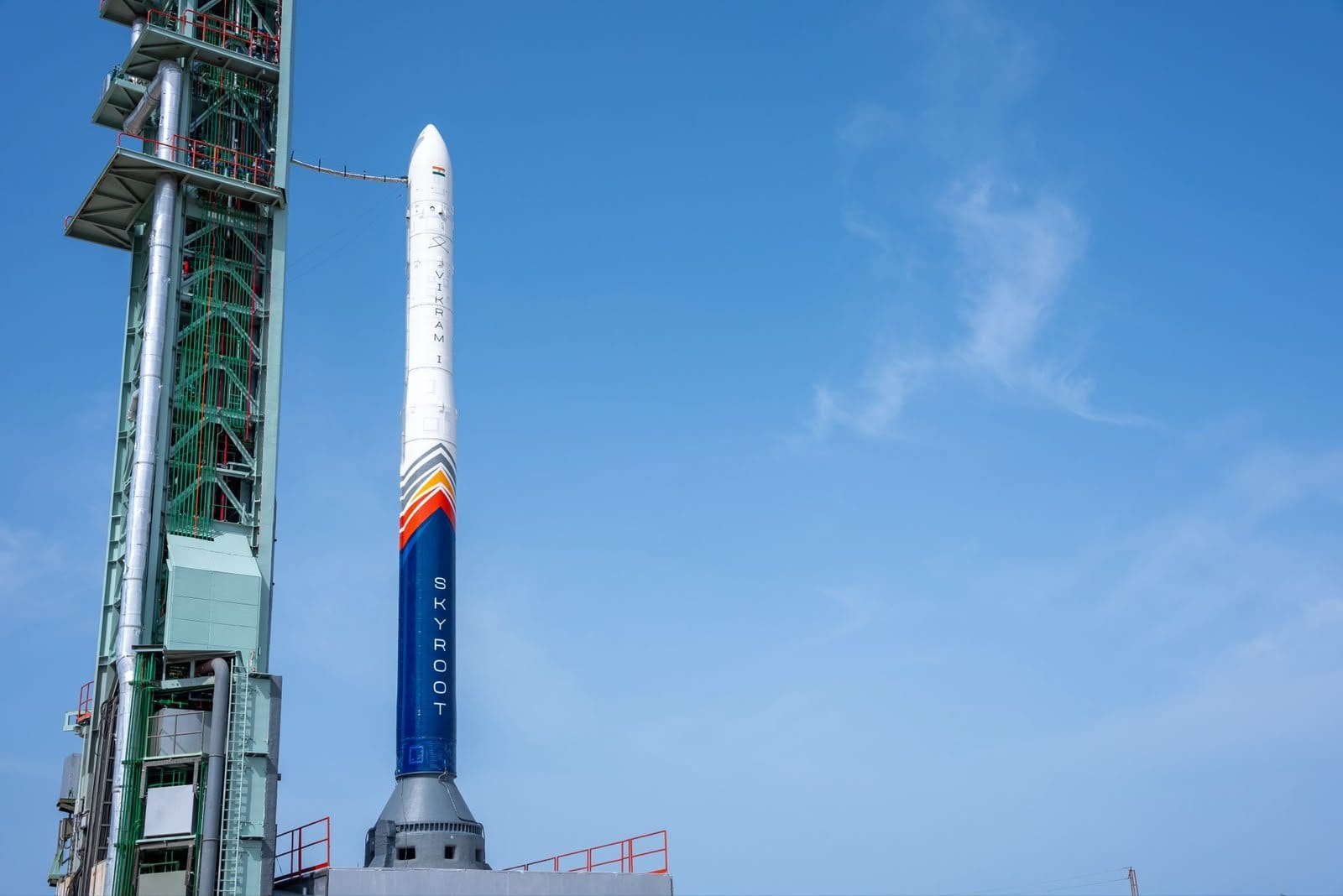
Vikram-1 stands fully stacked on the launch pad at the Satish Dhawan Space Centre, Sriharikota, ahead of its historic first flight.
Our Role in the Mission
Ahead of this launch, Zetatek Technologies supplied Skyroot Aerospace with a precision 3-axis rate table — a motion simulator used for hardware-in-the-loop (HWIL) simulation and calibration of the rocket's inertial sensors. This system replicates the exact rotational motion a rocket experiences in flight, allowing engineers to test and calibrate gyroscopes and IMUs (inertial measurement units) under conditions that closely mirror real flight dynamics, long before the vehicle ever leaves the ground.
In addition to the rate table, Zetatek — through our partner companies — also supplied IMUs and gyroscopes that contributed to the sensor suite validated on this platform.
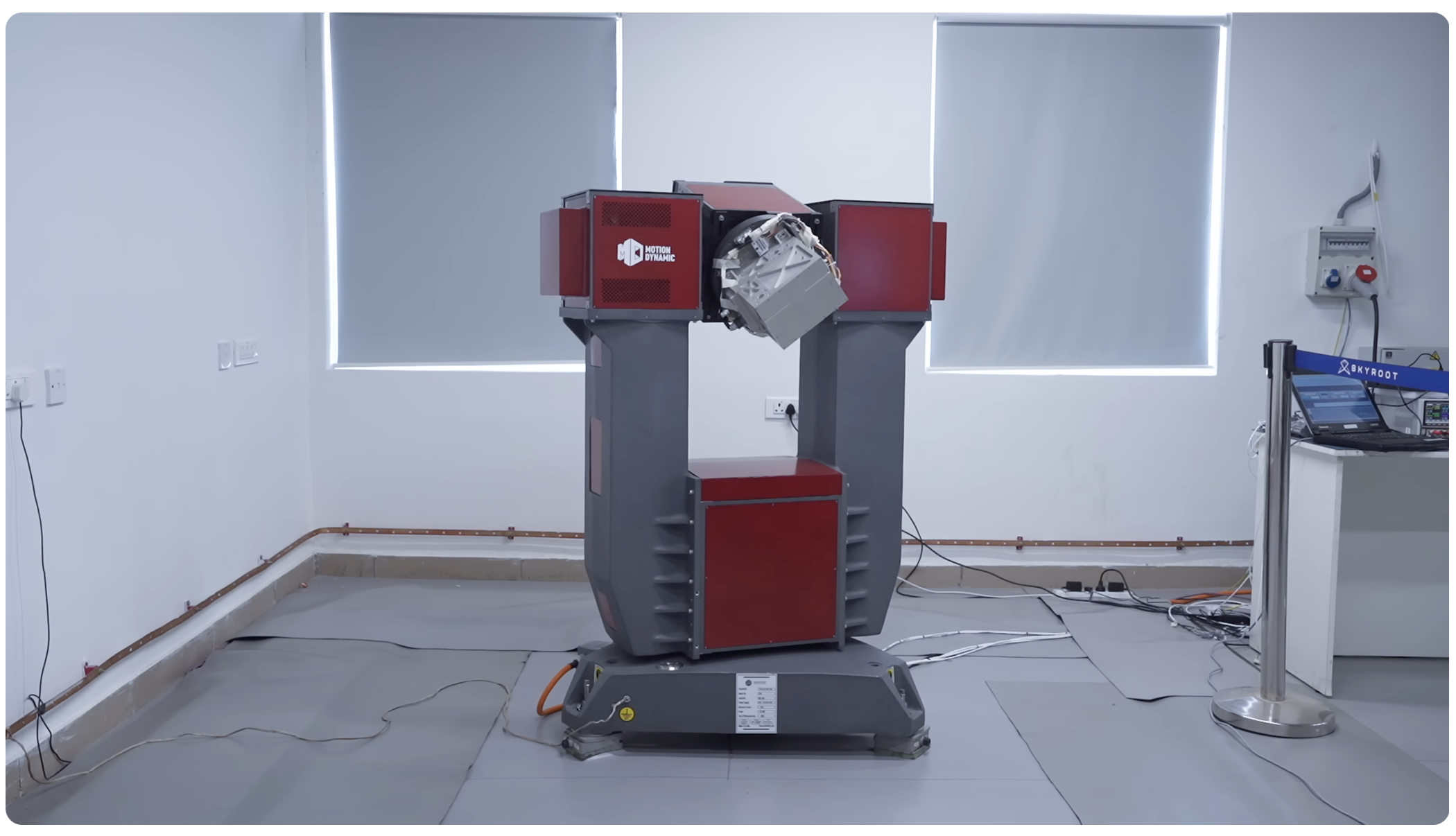
The Zetatek 3-axis rate table (motion simulator) supplied for hardware-in-the-loop calibration of Vikram-1's inertial sensors
Readers familiar with our earlier work may notice the "Motion Dynamic" branding on the equipment in the image above. Motion Dynamic was previously a distinct entity within the Zetatek Group, focused on precision motion simulation systems; it has since been fully merged into Zetatek Technologies Pvt. Ltd.
A Proud Milestone, Built on Trust
Vikram-1 is a four-stage, orbital-class launch vehicle designed to place small satellites into Low Earth Orbit, and today's flight — reaching an altitude of roughly 450 km — validates years of indigenous engineering by Skyroot's team. Being trusted with a role in the calibration chain for a mission of this magnitude, on Indian soil, is exactly the kind of opportunity that reflects why Zetatek exists: to build precision motion and test systems that our nation's most ambitious defence and aerospace programmes can rely on.
We extend our heartfelt congratulations to Skyroot Aerospace, ISRO, IN-SPACe, and every engineer and technician who worked tirelessly to bring Mission Aagaman to life. We are equally proud of the Zetatek and Motion Dynamic engineers, technicians, and support staff whose precision, patience, and long hours went into designing, building, testing, and delivering a system that had to work flawlessly — because on a mission like this, there is no margin for error.
Watch the Launch
Relive the moment Vikram-1 cleared the tower and headed for orbit:
▶ Watch Mission Aagaman — Vikram-1 Launch Video
Looking Ahead
Milestones like Vikram-1 don't just mark a successful test flight — they signal the arrival of a credible, private Indian launch industry, and a growing home market for the kind of high-precision test and simulation infrastructure Zetatek builds. As Skyroot and other Indian space companies move toward more frequent, on-demand orbital launches, we look forward to continuing to support this ecosystem with the rate tables, gimbal platforms, and environmental test systems that help take Indian-built hardware from the lab to the launch pad — and beyond.
Congratulations once again to Team Skyroot. Jai Hind, and here's to many more Indian rockets reaching orbit.